


The period following Shelby County v. Holder has been marked by rampant voter suppression, but while its democratic erosion implications have been well-studied, little work to date has examined these shifts through the lens of political determinants of health. Without the Umbrella: Voter Suppression and America's Growing Health Divide seeks to do just that through a book manuscript that combines survey data, interview evidence, and analysis of administratively and financially burdensome voting law, their effects on voting access for those with illness and disability as well as broader reliance on the American safety net, and the resulting policy feedback effects as voting laws undercut democratic responsiveness to this population's health needs. Existing research shows that policy design can impose unequal administrative burden, but no study has examined how post-Shelby County voting restrictions may reinforce health inequality by reshaping who can realistically participate in elections. This work assesses these voting laws as a driver of not just economic, but health inequity, situates America's continued laboratories of democratic erosion in the lens of administrative burden, and lays bare the extent to which these institutions shape both health policy adoption (potentially driving worse health outcomes that make burden even more salient) and associated issues of privatization and redistribution as well as shaping voters' (or would-be voters') political engagement. By unpacking the relationship between restrictive/expansive voting regimes following Shelby County v. Holder and health policy and disability, this work will highlight the changing landscape of political determinants of health and representation.
Meet the Grantees
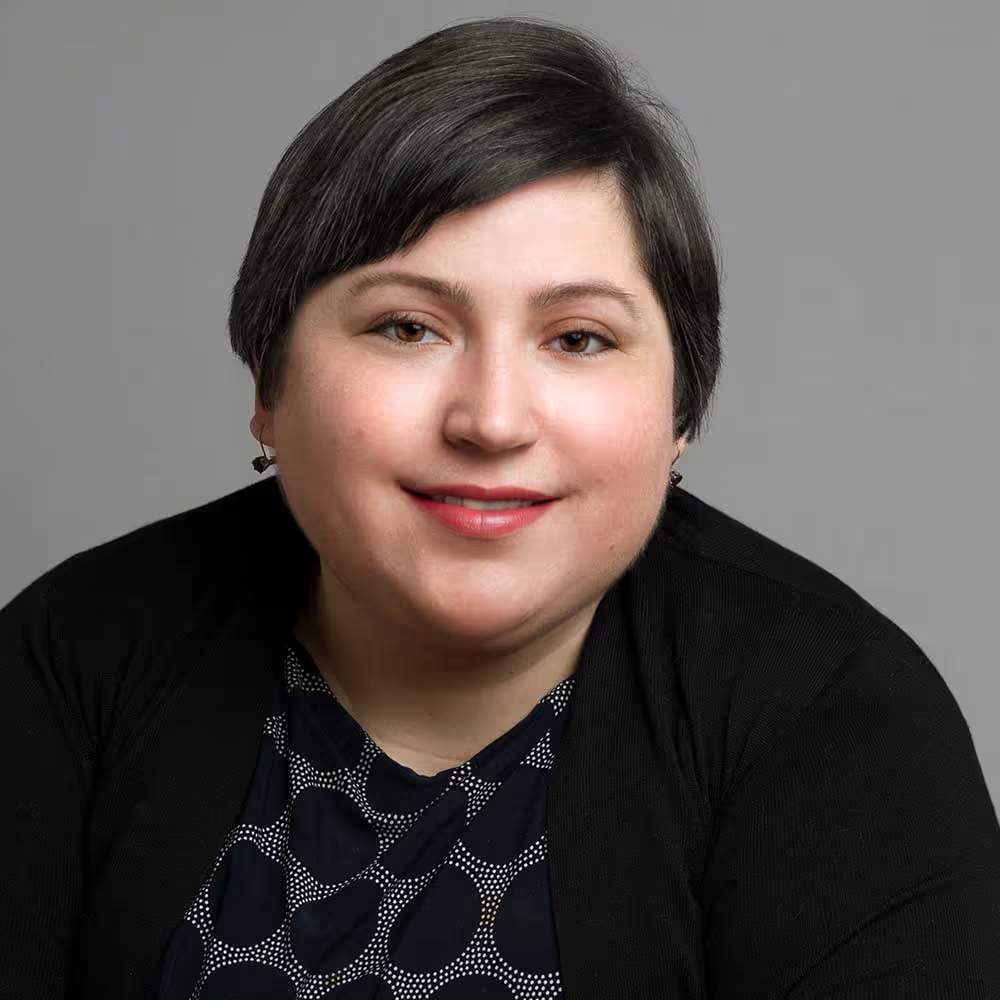
Miranda Yaver
Faculty member
|
University of Pittsburgh
Miranda Yaver is an Assistant Professor of Health Policy and Management at the University of Pittsburgh, where she holds secondary appointments in the Department of Political Science and the School of Public and International Affairs. She was the 2025 author-in-residence and Healthcare Fellow at the Roosevelt Institute, in addition to which she co-leads the Central Pennsylvania chapter of the Scholars Strategy Network and is an AcademyHealth Champion for Health Services and Prevention Research. Her research draws on American political economy, health policy, and law to examine health insurance disparities, administrative burdens in health care, and the politics of health reform. Her forthcoming book Coverage Denied: How Health Insurers Drive Inequality in the United States (Cambridge University Press, April 2026) examines the politics driving health insurance barriers and how they deepen inequities in health care delivery through their deepening of patient and physician administrative burden. Her research has appeared in such journals as the American Journal of Political Science, Journal of Law, Economics & Organization, Journal of Health Politics, Policy, and Law, JAMA Pediatrics, World Medical & Health Policy, Lancet Regional Health-Americas, and Health Affairs Scholar, with additional health policy analysis in such outlets as The New York Times, The Washington Post, The Guardian, The Hill, MS NOW, NPR, CNBC, and CBS Sunday Morning


