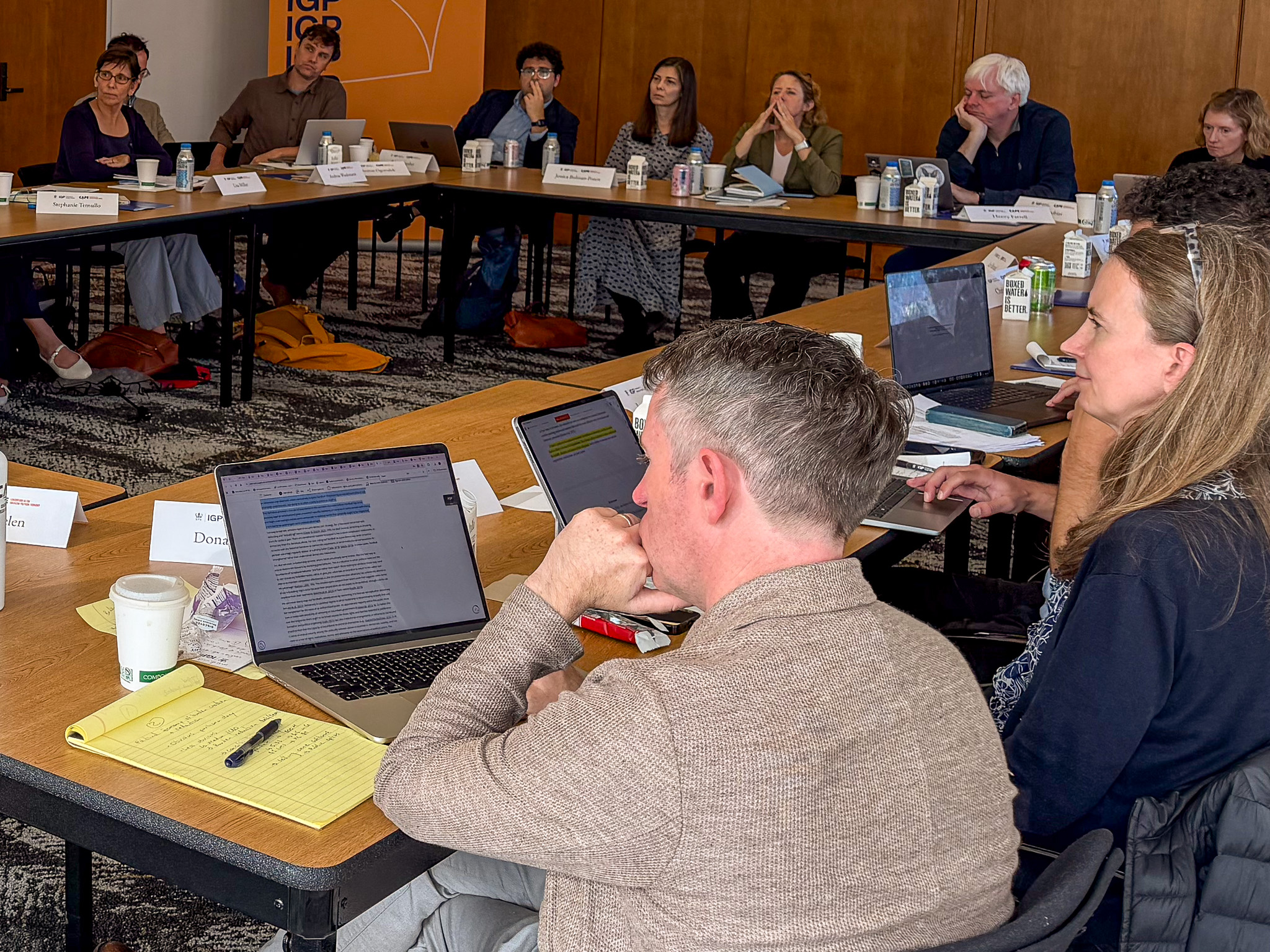
In October 2026, 26 political scientists, legal scholars, NGO practitioners and policy experts from institutions across the United States and Europe gathered at Columbia’s School of International and Public Affairs (SIPA) for a workshop. The two-day event was convened by Columbia’s Institute of Global Politics (IGP) and the Consortium on the American Political Economy (CAPE) with an ambitious goal in mind: to sketch out a research agenda for the next chapter of the American political economy.
Participants did not present finished papers. Instead, each circulated a three-page memo in advance, making the case for an area that deserves more scholarly attention going forward. Participants then took stock of what has changed (e.g., the role of money in politics), what has not (bipartisan indifference to addressing it), and where research is most needed: how AI will affect democratic governance, whether the world will keep investing in American assets, and how a weakened administrative state will function, among other questions.
A central theme throughout the event was that the era of “business as usual” has come to an end. In talk after talk, participants doubted that the US would revert to the old normal and urged colleagues to revisit long-settled assumptions about how the American political economy works. As Paul Pierson (UC Berkeley) put it: “As a person who made a living out of telling people it’s politically impossible to cut social benefits, I’m beginning to think they may have finally cracked the code.”